
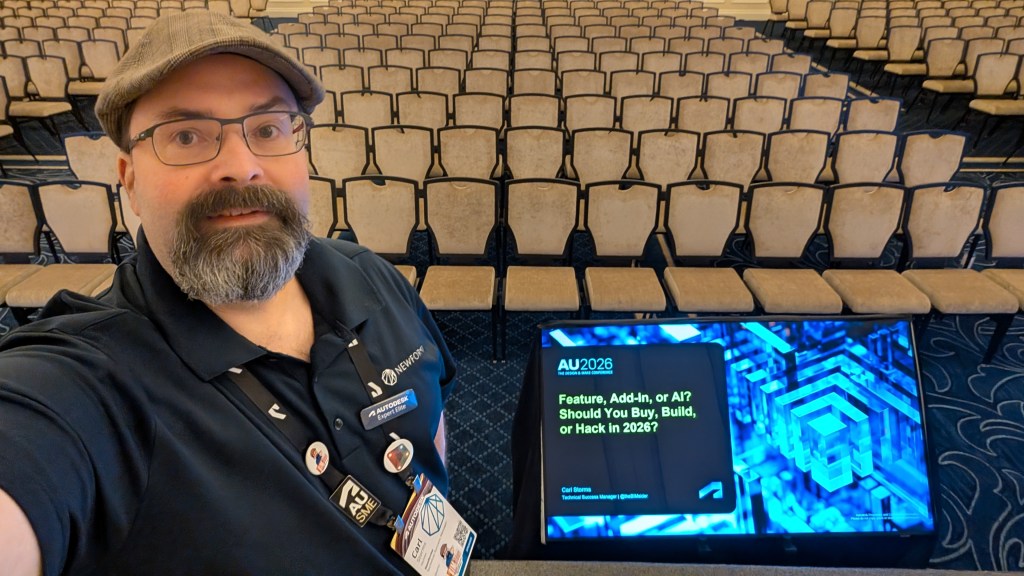
Autodesk University was back in Las Vegas this year, and it just felt right. But it wasn’t the AU of old.
After being away from speaking at AU since 2020, it was good to be back. This year had me wearing a few different hats: speaking again, continuing my work in the SME program (previously the Speaker Mentor Program), attending the EE Summit, and spending a good chunk of time at the Newforma booth… I’m tired just writing that all out. 🥱
But as the week went on, I started noticing that things felt a little different. After spending so many years at AU in this exact location before COVID, I think I came back expecting the same old AU.
I guess you can’t really go back.
Well, not in time anyway, because AU just works better in Vegas. It’s set up to handle a conference the size of AU, with 10,000 to 15,000 people. It’s typically pretty easy to get to from anywhere in the world, and it has its own type of energy and excitement that lends itself well to a tech conference.
I know it’s not everyone’s cup of tea, and some people do like the idea of moving locations each year. But from a logistics point of view, it really just needs to stay in Vegas.
So, what did my week at AU actually look like? A little bit of everything, as it turns out.
Day 0 – EE Summit
My Autodesk University kicked off with the Autodesk Expert Elite Summit. This was my second time attending the Summit, which takes place the day before Autodesk University officially gets underway.
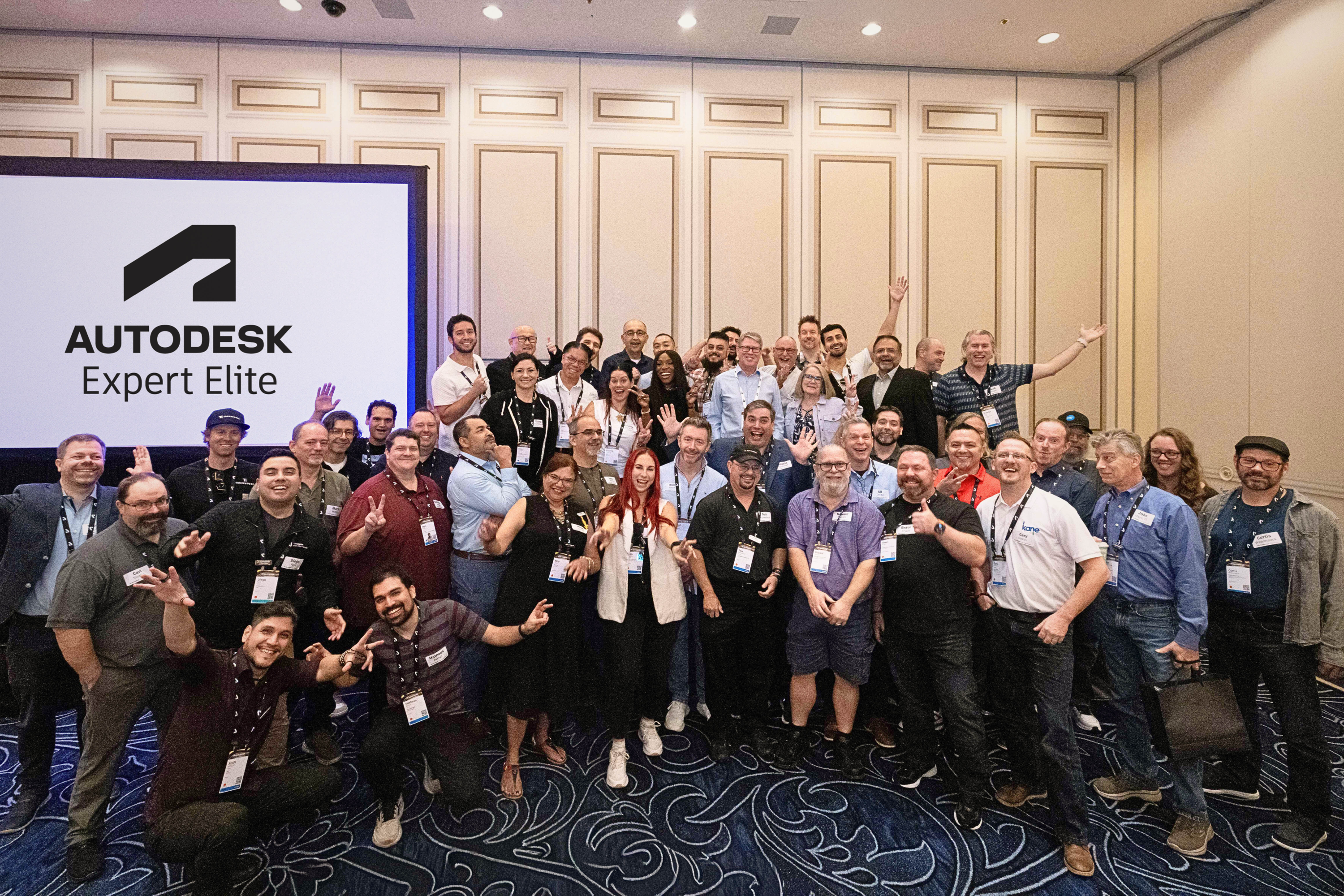
It’s always great to get back together with so many incredible people from across the industry. I’ll admit, sometimes I get a little impostor syndrome hanging out with all the super-smart people in the room. But that’s also what makes the Summit so valuable. It’s a great day of talking shop, hearing what’s new from Autodesk, getting access to software experts and executives, and catching up with fellow Expert Elites from around the world.
And, of course, we have to end the day with the Expert Elite happy hour. Last year in Nashville, we made custom hats. This year, we headed to Flight Club in the Canal Shops, a pretty cool dart pub where there’s no scorekeeping required because it’s all automated! That turned out to be a great way to wrap up the day.
Not a bad way to kick off AU, before it even started. 😉
Back on the AU Stage
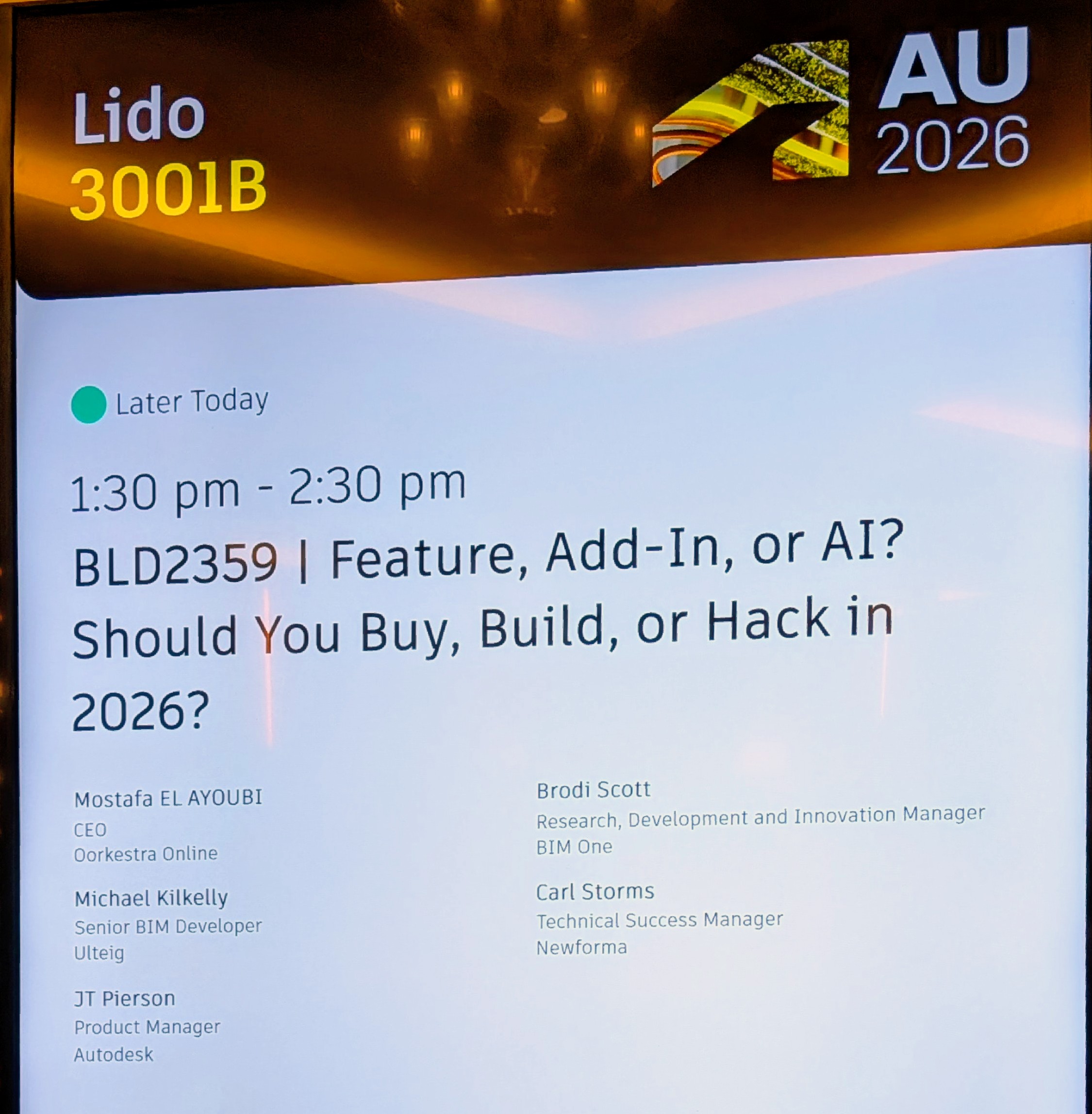
I submitted two sessions this year, one under the limit of three per speaker. That’s a far cry from the days when I would submit 25.
The session that got picked was a panel about AI, which seemed to be the theme of most of the classes this year.
Feature, Add-In, or AI? Should You Buy, Build, or Hack in 2026?
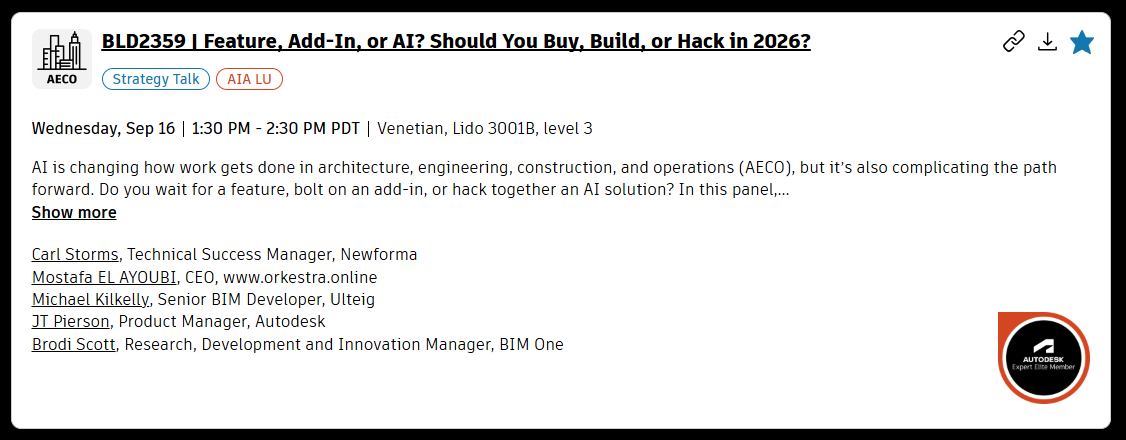
It was a great session, with lots of conversation, debate, knowledge sharing, and even a few laughs. It came to a fitting end as some of the 286 attendees stepped up to the mic and asked some really well-thought-out questions of our panel.
Those questions weren’t just about what we had talked about in the session. They showed that people are thinking about how to take what they and their firms are doing to the next level, while also wrestling with what the future looks like with all things AI.
Will the next generation lose the drive to learn and just ask ChatGPT?
Spoiler: No.
And the fact that people are thinking about and asking that question is exactly why conversations like this are important.
Of course, I want to once again give a huge thank you to the panelists extraordinaire:
🌟 Mostafa El Ayoubi El Idrissi, CEO of Orkestra Online & Co-Founder of data|shapes
🌟 Michael Kilkelly, Senior BIM Developer at Ulteig & Founder of ArchSmarter
🌟 John Pierson, Product Manager, Dynamo at Autodesk
🌟 Brodi L. Scott, Research, Development & Innovation Manager at BIM One
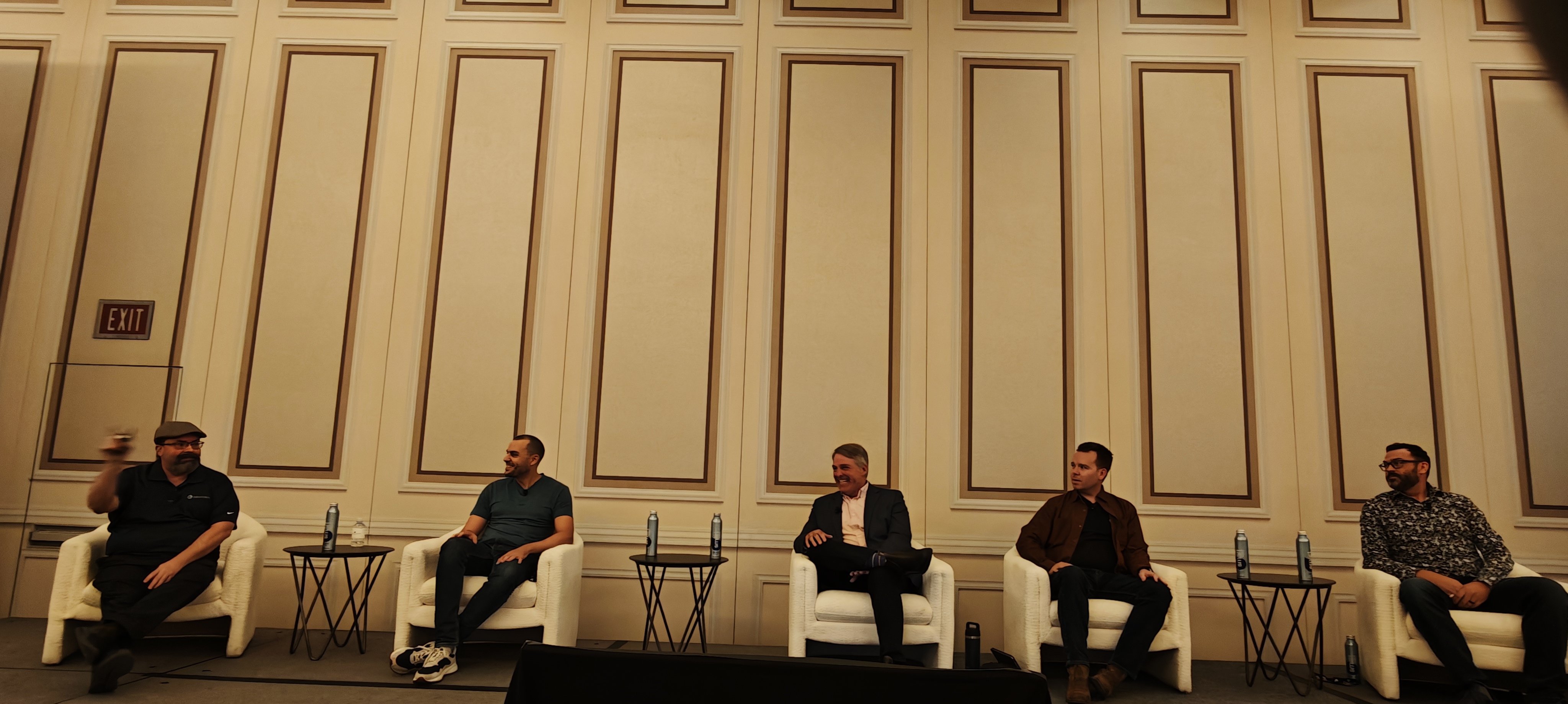
For those who attended and wanted a recap, or those who couldn’t attend and wondered what the panel was all about, follow this link to the class handout, presentation, and the hot-off-the-presses panel summary 👇
To finish, I’m sorry to say you won’t find the “Answer” in the summary. And that’s kind of the point.
This panel was never meant to give you an answer. Instead, it was meant to give you different points of view and real-world perspectives.
What works for one of our panelists in their daily workflow might not work for yours. Hopefully, there was enough insight to help you forge your own path for your unique problem and figure out how best to solve it for you, and you alone.
Enjoy that new feature, the latest Add-In, or the new AI hack you got done just in time for that one-off data challenge!
Note: If you’re looking for the session content on the AU 2026 website or app, the Handout and Presentation should be there. The Panel Summary is still a work in progress. I’ve submitted it, but depending on when you’re reading this, you might see the old “Additional Materials” PDF, which is just blank. Apparently, you can’t check that item off your AU Speaker to-do list unless you’ve uploaded something, and I needed to have all the boxes checked. 😜
SME Program
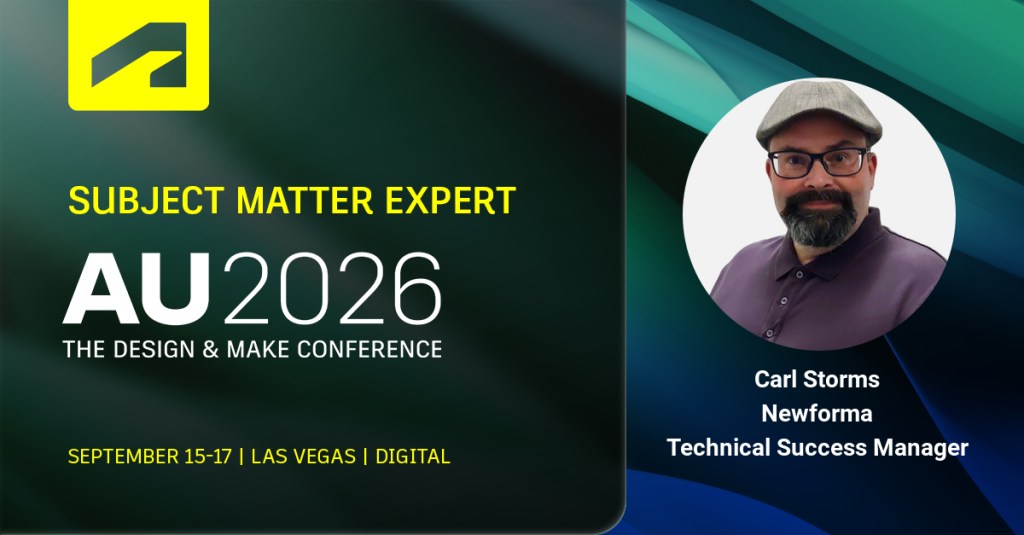
I was happy to take part in the SME program again this year. SME (Subject Matter Expert) is the latest version of the Speaker Mentoring program that the AU team runs each year. The idea is pretty simple: help people who are speaking at AU for the first time get advice from experienced speakers and SMEs, so they can have the best experience possible.
The program has morphed over the years in terms of how mentors and mentees get connected. This year, speakers simply checked a box if they wanted to opt in to having an SME reach out to them. There are always more mentees than mentors, and this year I reached out to four. Two got back to me and we set up Zoom calls.
The AU team also had the SMEs write blog posts, so speakers who may have missed the checkbox, or who changed their minds after the fact, could reach out to SMEs through the speaker forum. I had someone reach out to me that way as well, and we set up a call.
Now, not everyone who signs up is a first-time speaker. Some have spoken, but never at AU, so they just want to have a chat with someone who’s done it before. They want to know what it’s like, how it might be different from other conferences they’ve spoken at, and make sure they know what they’re getting into.
For others, it’s their first time speaking, at least at a convention as big as AU, and they’re looking for more than just a chat. That’s when we set up calls at different stages along the process to make sure they’re ready for everything AU speaking requires.
For me, and the people I work with, that typically means monthly calls leading up to the event. It’s definitely a two-way conversation. I want to hear what they’re speaking about, why they chose the topic, how they’re thinking about presenting it, and what experience they already have speaking or presenting. From there, I can share my own experience, along with tips and tricks I’ve picked up along the way from people who have shared their speaking knowledge with me, like the great Marcello Sgambelluri.
I find that just having those check-in dates helps keep new speakers on track. I also offer to review and provide feedback on handouts and presentations along the way.
This year was a bit of a bummer because I wasn’t able to see any of my mentees speak. Between our sessions being scheduled at the exact same time (what are the odds?) and my booth duties, it just didn’t work out.
But I was very happy that a couple of the mentees I worked with came and found me to say hi IRL. I didn’t get to see their sessions, but I know they killed it because they were prepared, experts in the topics they spoke about, and genuinely passionate about what they do. That always shines through when you’re speaking.
Congrats, guys! 🎉
Booth Beard
While this was my first time speaking at AU in person since 2019, I’ve been back for every in-person AU since things started up again in 2022 in New Orleans. For all of those shows, I was helping out at the Newforma booth, and this year was no different.
Attending a conference like AU to work a booth in the Expo Hall is very different from attending sessions, or speaking for that matter. You are there to work. You put in long days in the Expo Hall, talk to a lot of people, answer a lot of questions, and make sure there is basically no booth swag left behind when it is time to pack everything up at the end of three days. 🤞
Now, that might make it sound a little rougher than it really is. Yes, I am there as part of my job, but it is also a lot of fun. You get to connect with colleagues you don’t get to see every day, along with industry friends and clients, both old and new.
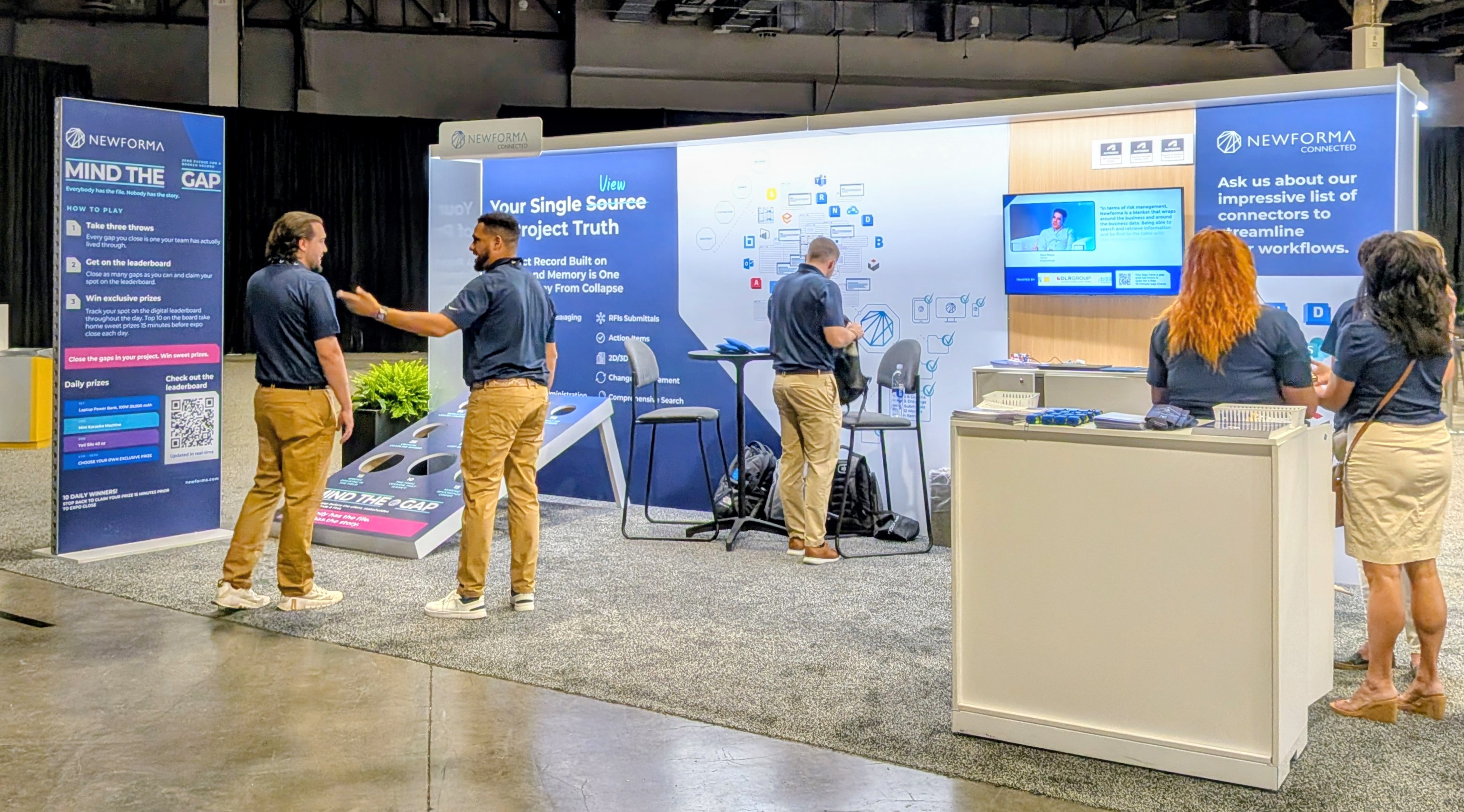
I also get to share what Newforma has been working on since the last AU, talk about the latest and greatest with Newforma Konekt, and generally chat about what is going on in our industry. Can you say AI?
We also have a great Marketing and Events team at Newforma, so there is always a fun twist at the booth to help bring people in. This year, that was our “Mind the Gap” game. Basically, our take on cornhole, where you had three bean bags and tried to get the highest score. The top 10 each day won prizes, and you could play again each day.
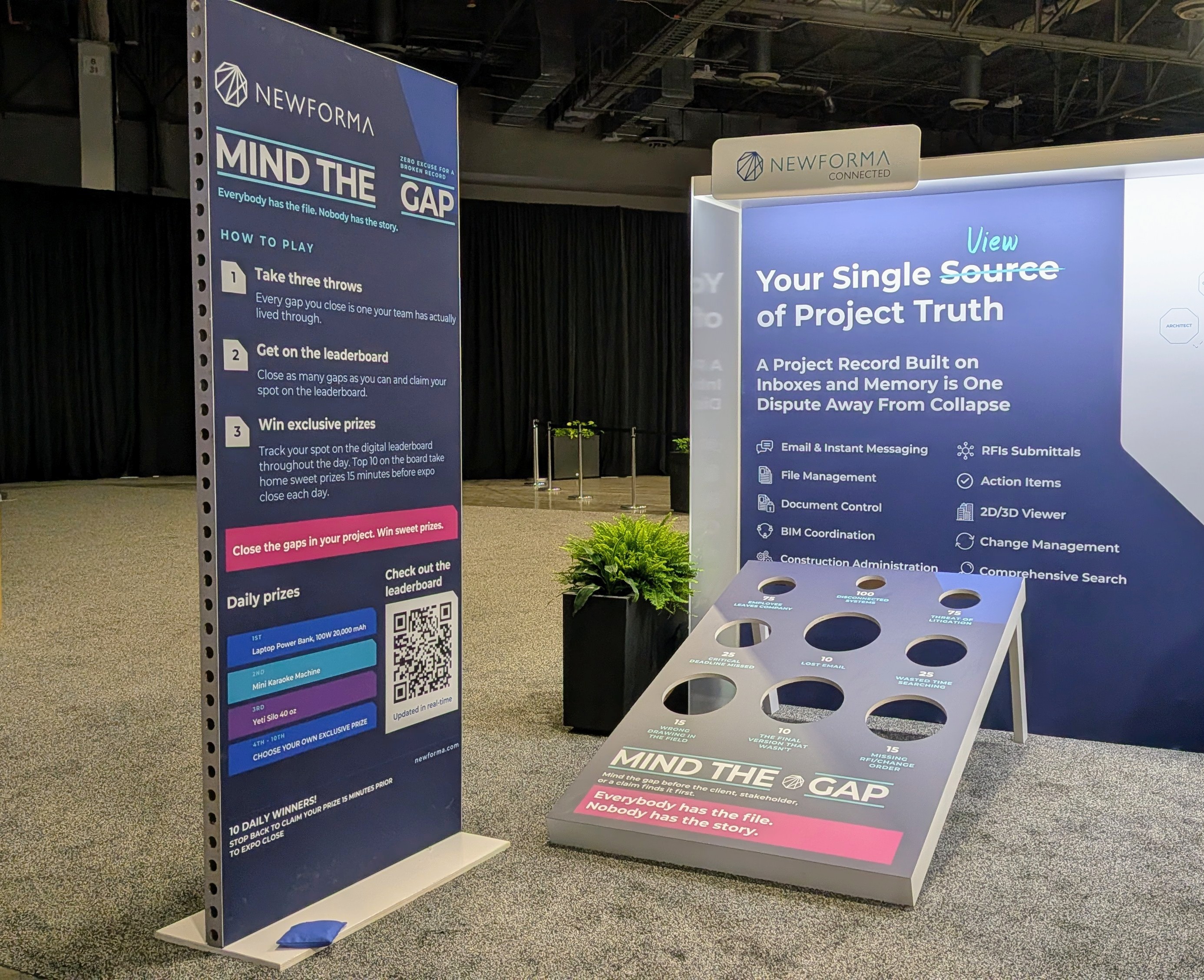
Keep them coming back each day. Smart marketing folks. 😉
I also learned that there are some seriously good cornhole players hiding out in the AECO industry! I guess we know what the next AECO sporting event needs to be.
Stay tuned for what the Newforma booth will have in store for AU 2027. 👀
The New AU
Well, being back in Vegas felt right for AU. But by the end of the week, it was pretty clear that this wasn’t the Vegas AU of old.
There seemed to be more sessions led by Autodesk employees or sponsors. I’m not sure whether that is actually a fact or just perception. In the past, Roadmap and “What’s New” type sessions didn’t always end up as official sessions in the catalog, whereas now they do. And, of course, it is an Autodesk conference, so there are plenty of people who are there specifically for that content and are happy to have more of it.
There is also the argument that some of the “veteran” AU attendees are longing for the days of more complex and advanced content from all their favorite speakers, just like the good old days. But maybe it’s really less about the content and more about the good old days?
This was also the second year of first-come, first-served registration for classes, with the exception of hands-on labs. I really noticed this year how it led to long lines, with people still not getting into the classes they wanted.
Now, the old way of having everyone pick their classes ahead of time wasn’t perfect either. The popular classes would “sell out” almost immediately, and people who had registered didn’t always show up, leaving empty seats. With a conference the size of AU, and with that many people trying to get into the same sessions, I’m not sure there is a perfect answer. But maybe a hybrid approach could work?
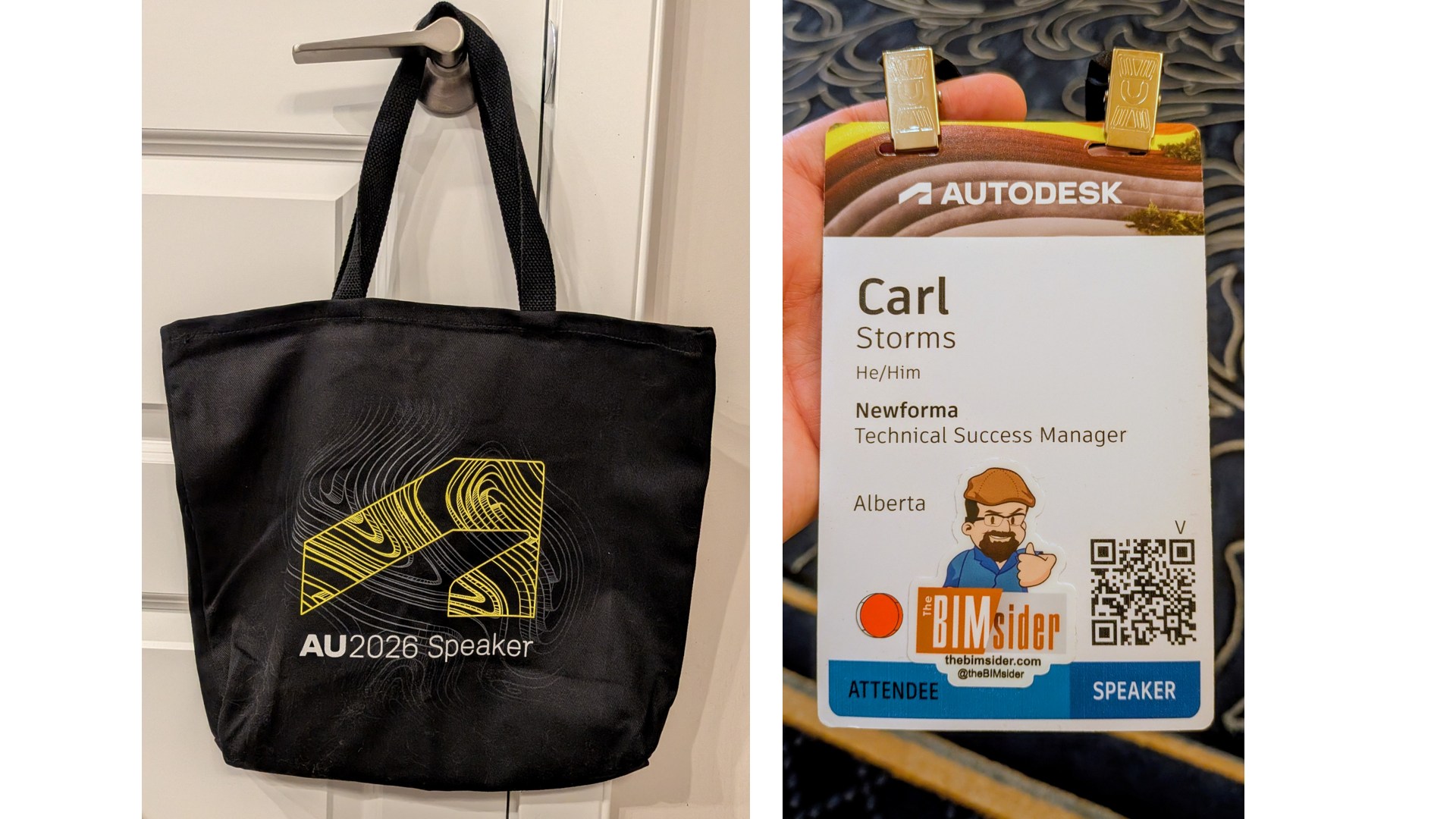
It has been a while since I spoke in person at AU, but I have to admit, I miss the speaker shirts.
This year, speakers got speaker bag instead. It’s a nice reusable shopping bag, and I know change is good, but I miss the shirt. I have a closet full of them, and next to my AU badge, the speaker shirt was always one of my favorite pieces of AU swag.
I’m not even sure when they made the switch. It may have been this year. I was a co-speaker, actually a lab assistant, in 2024 and received a speaker shirt that year. It was the “baseball” style shirt with the 3/4-length sleeves.
Maybe I’m just a little too attached to my AU Speaker shirt collection. 😂
Then there is the Expo Hall.
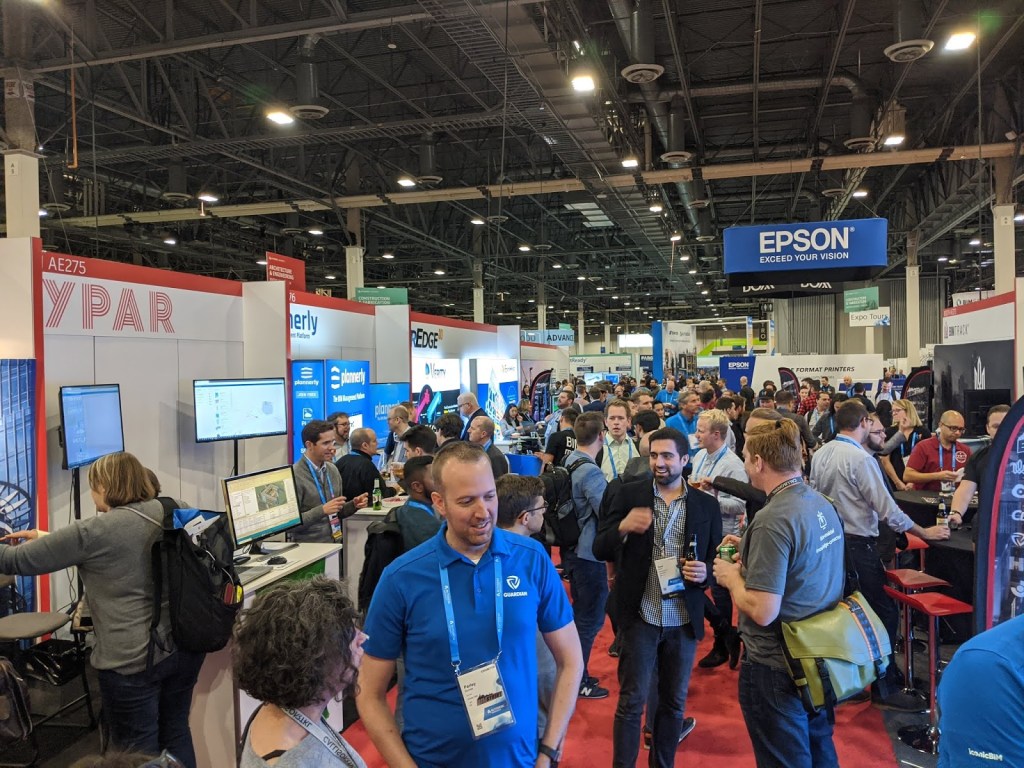
This year it was bigger, with fewer vendors, or “sponsors,” as they are called at AU. That meant more space, but also fewer people in that space. You could tell almost immediately when you walked in. After doing your first lap around the Expo Hall, it became pretty clear that it wasn’t just because AU was back in the Venetian. There were simply fewer booths.
There were a lot of Autodesk booths and activity centers at the front of the Expo Hall, along with large stages in the corners for sponsored presentations during Expo Hall hours. They also moved the food service away from the Expo Hall, so attendees didn’t need to come into the Expo Hall during lunch if they didn’t want to.
All of those things added up to less traffic at the booths.
I know it might sound like more space and less competition would be a good thing. But if it means less foot traffic, and fewer reasons for people to even go into the Expo Hall, then I don’t think it is.
Does anyone remember how full the Expo Hall was back in 2018 and 2019? The “BIM Street” days, if you know, you know. 😏 You would be shoulder-to-shoulder walking through the Expo Hall, waiting in line to talk to your favorite vendor, and finding a ton of new booths you didn’t even know existed before you saw them at AU.
So how do we get more sponsors back next year? Maybe make the booths less expensive? I’m sure there are plenty of other ideas.
But if the goal is also to get more people into the Expo Hall, I’d start with the food.
Bring the meals back into the Expo Hall, or at least have them immediately attached to it rather than on the floor below. You could also move the Autodesk booths and activity centers toward the back of the Expo Hall. People are there to see Autodesk. They will walk to the back to see them.
That gets more people moving through the Expo Hall and past the sponsor booths.
Seems like a win-win to me.
That’s a Wrap
Well, another year and another AU is in the books. Maybe it just wasn’t the nostalgic AU I was hoping for, but it was still a pretty great week.
Expo Hall aside, if you made your way over to the class section of the conference center, you could feel the energy. That was the energy of the AU in Vegas that I remember. It just would have been amazing to have that same energy everywhere.
They also brought back a fan favorite with the LINQ Promenade Party on Thursday night. It’s always a great way to end the week, with something for everyone happening at the same time.
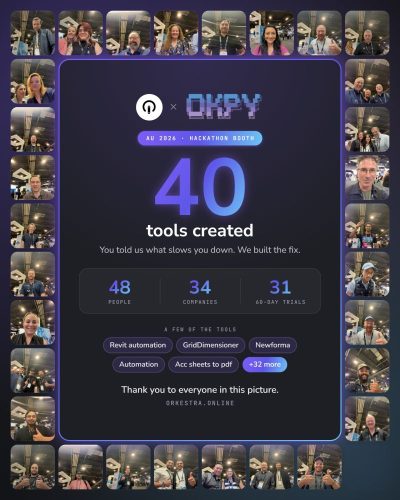
I also saw a brilliant idea for a booth in the Expo Hall. One of my panelists, Mostafa, had a booth for Orkestra, but the premise was a “Hackathon” booth to showcase the power and speed of his latest offering, OKPY Agent.
People would come to the booth with a real problem they were trying to solve. They could use OKPY to build the solution, and by the time they got their coffee from the AU Café next door, the working tool was done!
Next year, AU is officially back in Las Vegas at the same time of year. That’s definitely a little warmer than my nostalgic AUs of the past, which were always in November. As a Canadian, Vegas in November was a treat. Mid-September? It’s a little hot. 🥵
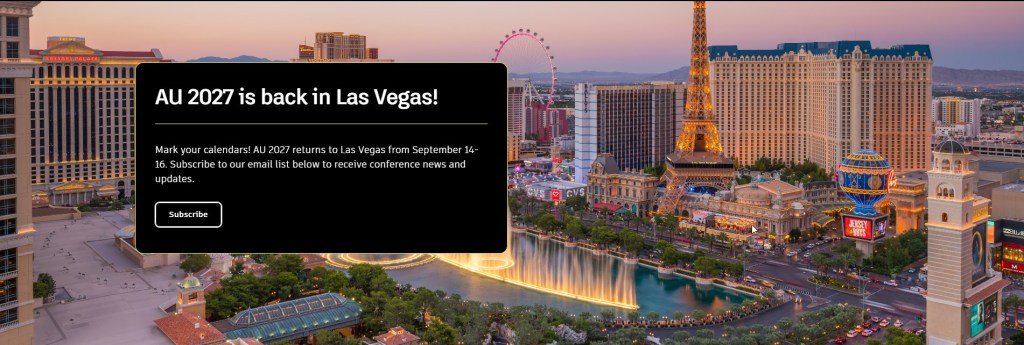
And, of course, the real reason to be back at AU in 2027 is connecting and reconnecting with all the amazing people in my network and across the AECO industry, like these three amazing people below. 👇
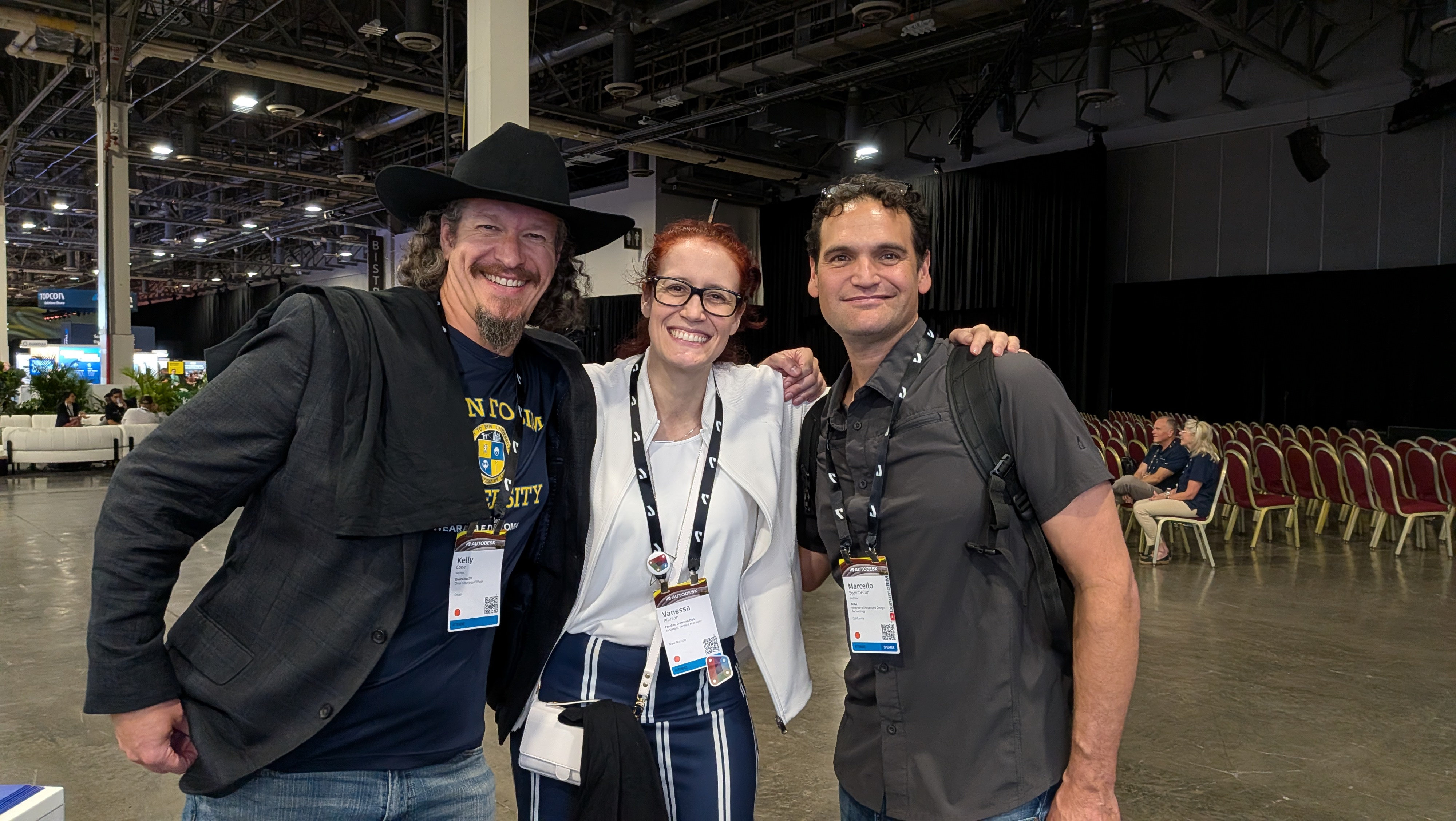
Hope to see you all in Vegas for #AU2027 🎰

All the Links: bio.link/thebimsider


1 thought on “AU 2026, Back in Vegas Baby!”