AECO, AI, BIM, Code-ish, Coding, Learning, LLM, Vibe Coding

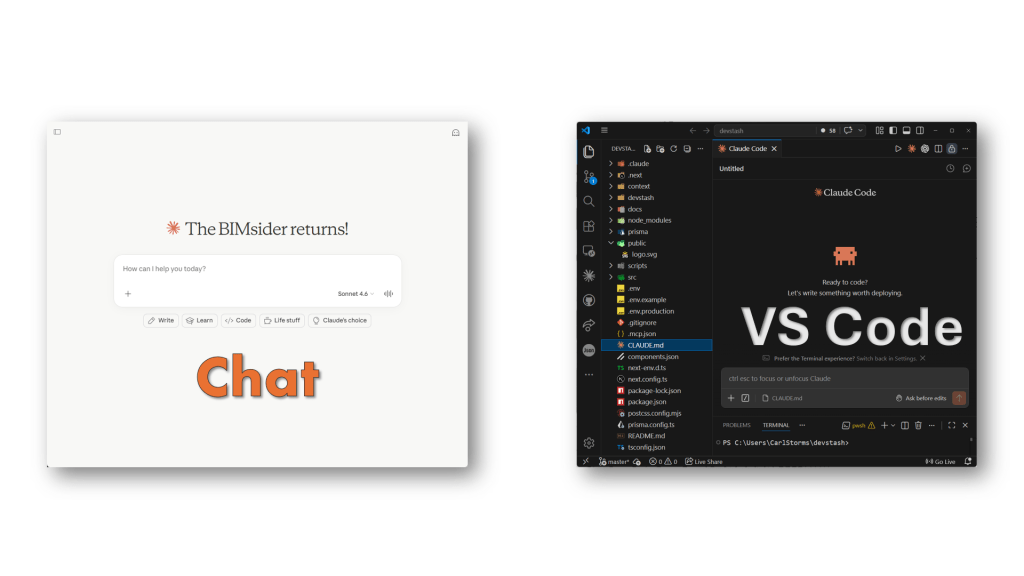
From Chat to VS Code: Somewhere Between Vibe Coding and AI-Assisted Coding

What changes when you take AI out of the chat window and into VS Code?

I recently completed a course from Brad Traversy at Traversy Media called Coding with AI.

I was looking to move beyond chatting with AI for my “vibe coding” sessions and into something a bit more structured. Up to this point, most of what I was building had to fit inside the limits of tools like Claude or ChatGPT in a browser. It worked, but as projects got larger and more complex, the cracks in that workflow started to show, especially if this was going to be more than just a weekend experiment.

I had dabbled with tools like Cursor, Windsurf, and early versions of Claude Code, but quickly realized I wasn’t ready for them yet. Or maybe I just didn’t need that level of horsepower. Or maybe I wasn’t ready to give up that much control. Likely a mix of all three.

That shift, from chatting with AI to working with it inside VS Code, sounds small. And technically, it is. But it changes how you work more than you think. It comes down to the difference between what the course calls “vibe coding” and AI-assisted coding. I’ll get into that distinction in a bit.

This isn’t a course review, but I liked it enough to go through it twice. Once using Claude Code, and again using Codex. Same material, different tools, slightly different experience each time.

And that’s what got me thinking. Where’s the line between vibe coding and AI-assisted coding? More importantly, where do I actually sit on that spectrum, and what do I gain by moving out of the chat window and into VS Code?

This isn’t a course review, but I liked it enough to go through it twice.
Continue reading “From Chat to VS Code: Somewhere Between Vibe Coding and AI-Assisted Coding”
AECO, AI, BIM, Code-ish, Coding, CSS, HTML, JS, openBIM, Vibe Coding

Just the Fields: A Simpler Way to Explore Large (and Messy) JSON Data

Solving the mystery of your JSON, one field at a time. 🕵️.

I have been doing a lot of work with JSON lately, which got me thinking. There has to be a better way to view all this data.

Technically, JSON is human-readable. But once you are dealing with hundreds or thousands of data points from an API response, it quickly stops feeling very human-friendly. Large responses turn into walls of nested objects and arrays, and even with formatting or collapsible trees it can still be difficult to quickly find the pieces of information you actually care about.

JSON is technically human-readable.
Until it is 5,000 lines long.

Continue reading “Just the Fields: A Simpler Way to Explore Large (and Messy) JSON Data”
100 Days of AI, AEC, AECO, AI, BIM, Coding, Learning, VDC

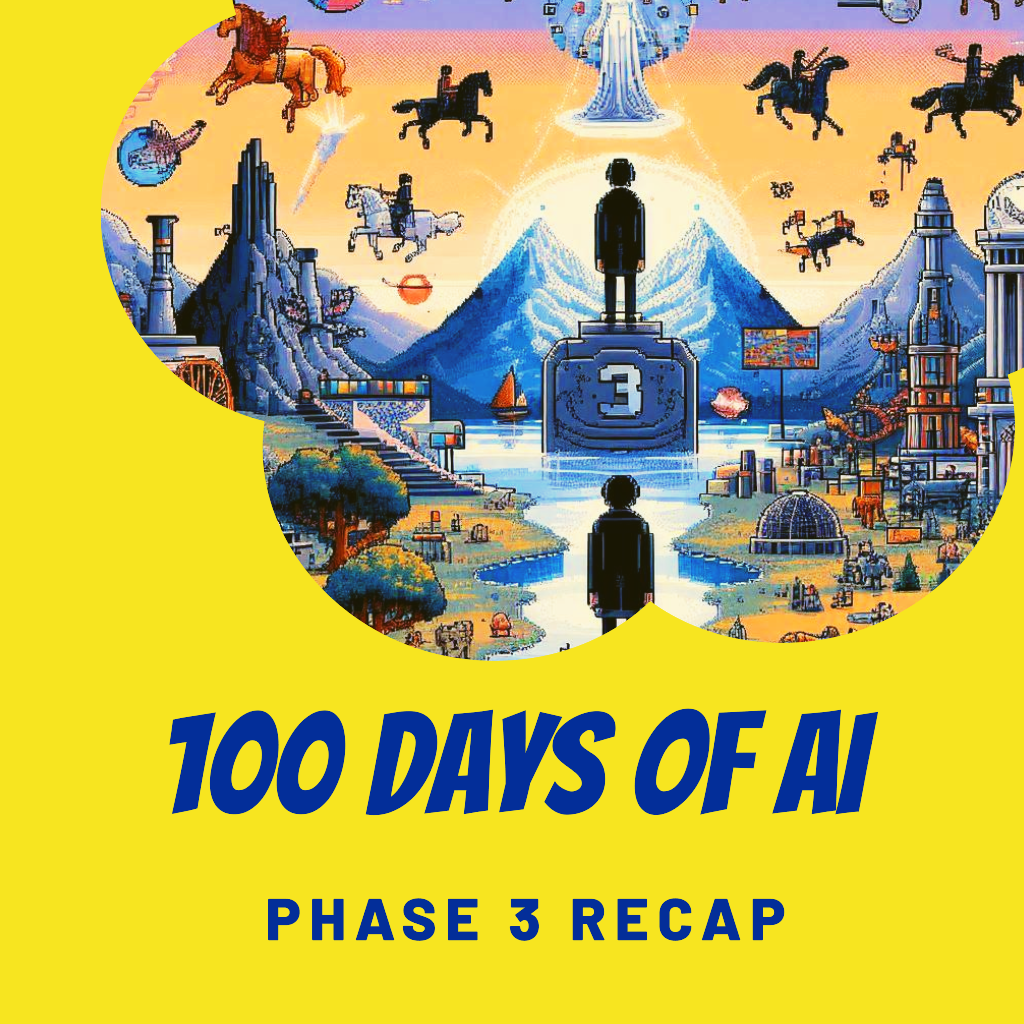
100 Days of AI – Phase 3 Recap

As we dive into the third phase of the #100DaysOfAI challenge, things are getting interesting! We’re building on the strong AI foundations and exploring cool use cases from earlier stages. This phase is all about putting our new AI skills to the test on “real-world” problems and pushing the limits of what we can do with the tech we’ve gotten the hang of. Come along as I chat about the adventures and breakthroughs in this final stretch, where we’re turning theory into practice and learning into some seriously cool innovation.

Continue reading “100 Days of AI – Phase 3 Recap”