
The rush of getting code to vibe
Remember your first hackathon? That wild, caffeine-fueled moment when code actually worked on the first try? Even if you’ve never been to one, you know the feeling when everything just clicks and ideas start to flow faster than you can type. Vibe coding feels like that, only this time it happens on an ordinary Tuesday afternoon with no sleep deprivation required.
This post is part one of the three-part series “Vibe Coding: The Good, The Bad, and The Reality.” In this first chapter, we explore the excitement, creativity, and early wins that make vibe coding feel almost magical.
Vibe coding isn’t about knowing everything. Nope! It’s about staying with it long enough to build something real.
Vibe coding lives somewhere between creative flow and AI-assisted development. It is the new rhythm of building software fast, playfully, and with fewer blockers. It’s not about understanding every line behind the curtain, and there’s no need for perfect syntax or detailed documentation. It’s about energy. You are riffing with an AI coding BFF, chasing the spark that turns ideas into working prototypes before your focus fades.
It is coding with momentum.
Why Vibe Coding is Everywhere!
Because it’s fast. Like, “wow, I just built a working app in an hour” fast.

You start with an idea, maybe a tool, a dashboard, or a small automation, and within minutes AI is spitting out working code (or at least it looks like working code to those of us who can’t code 🤷♂️). The dopamine hit of seeing something actually run, with almost no setup friction, is addictive.
The appeal isn’t just speed, though. It’s momentum. Every prompt that lands feels like a win. Remember the first time you got a Dynamo graph to run on your own? Nothing could stop you. But this is where it gets different. Even when something breaks, you fix it in real time with your AI assistant. (Pro tip: you can use that same AI BFF to troubleshoot Dynamo graphs, and it does it surprisingly well.) The process feels alive, conversational, iterative, and fun.
It’s like jamming with an AI bandmate who knows every chord progression, lets you take the solo, and always tells you that you rock. The only catch is that they say it even when you miss a note. We will talk about that part later.
For those of us in AECO, the people doing the design, construction, and engineering, this way of working feels refreshing. You do not need to be a developer to enjoy the creative rush of seeing something come to life instantly.
Vibe coding turns technical problem solving into a kind of collaboration with AI, where curiosity matters more than code knowledge (although knowing how to solve the problem you are working on is still a big plus). It is about rediscovering that spark of creativity and momentum that makes digital tools fun again.
The Tools Behind the Vibe
Vibe coding starts with the tools that make creative flow possible. Some help you think and write, while others help you build and test. Together, they form the ecosystem that keeps ideas moving fast.
LLMs (Large Language Models): The brains behind the vibe
These are often the starting point for vibe coding. You can brainstorm, plan, or even write working snippets of code through natural conversation. Some even include dedicated code modes or extensions, such as Codex for ChatGPT or Claude Code for Claude.
- ChatGPT – All-around powerhouse for brainstorming, coding help, and creative prototyping.
- Claude – Excellent at reasoning through complex prompts and explaining workflows clearly. (Also my fav for coding)
- Gemini – Google’s AI suite built for quick integration with Docs, Sheets, and web data.
- Grok – X’s (formerly Twitter’s) playful, irreverent assistant built with real-time context.
- Mistral (Le Chat) – A fast, capable coding companion with plenty of free access and a refreshing, European point of view.
Vibe Coding Platforms
Once you are ready to take ideas further, these tools make it easy to design, test, and build in real time. Some work directly in your browser, others are extensions for your IDE (Integrated Development Environment). I am a fan of VS Code, but there are plenty of options, and some of these tools are full IDEs themselves.
- Bolt – Browser-based playground for rapid prototyping and sharing working web apps instantly.
- Cursor – AI-native IDE built on VS Code with smart inline suggestions and chat-driven editing.
- GitHub Copilot – The OG AI coding companion that turns natural language into code on the fly.
- Kilo Code – Lightweight, collaborative editor that blends code, chat, and live debugging.
- Lovable – “No-setup” AI app builder that spins up full-stack apps from a single prompt.
- v0 – Vercel’s visual UI builder that converts natural language into deployable React components.
- Windsurf – Fast, minimal AI IDE that lets you iterate code and context seamlessly in one workspace.
These tools are flexible, fast, and built for exploration. Whether you are experimenting with a workflow idea, automating a task, or creating something entirely new, they help you stay in flow and focus on the fun part, the creative momentum.
Projects: The Real Rabbit Hole of Vibe Coding

That’s the thing: vibe coding isn’t something you learn from watching, it’s something you feel by doing.
Like anything, you don’t really know until you try, and vibe coding is no different. Watching YouTube videos or following along with tutorials is a great way to learn the process of vibe coding, but you don’t truly get it until you use it on something for you, by you.
What I mean is using it to solve a problem that you are actually having, whether that is personal or at work. Ideally, the first time you try this, it should be a problem you already know the answer to, just not how to get there with code. That is where your AI bestie comes in to do the heavy lifting on the code writing and syntax side while you focus on what you already know. What is that saying again? “Teamwork makes the dream work.”
For me, I did lots of small tests based on tutorials or exercises from my 100 Days of AI and similar courses. (Those are great for learning and trying out many of the AI tools we talk about in this series.) Things like a simple landing page, a joke generator, one of my favorites, or a Pomodoro timer.
But one of my first real vibe coding victories came when I made a golf handicap tracker (Par-tracker 42). It was something I had wanted to build for a while. Yes, there were paid options out there, but they didn’t do exactly what I needed, and I did not want to be locked into a subscription for a few rounds of golf each year. So, I made it myself.
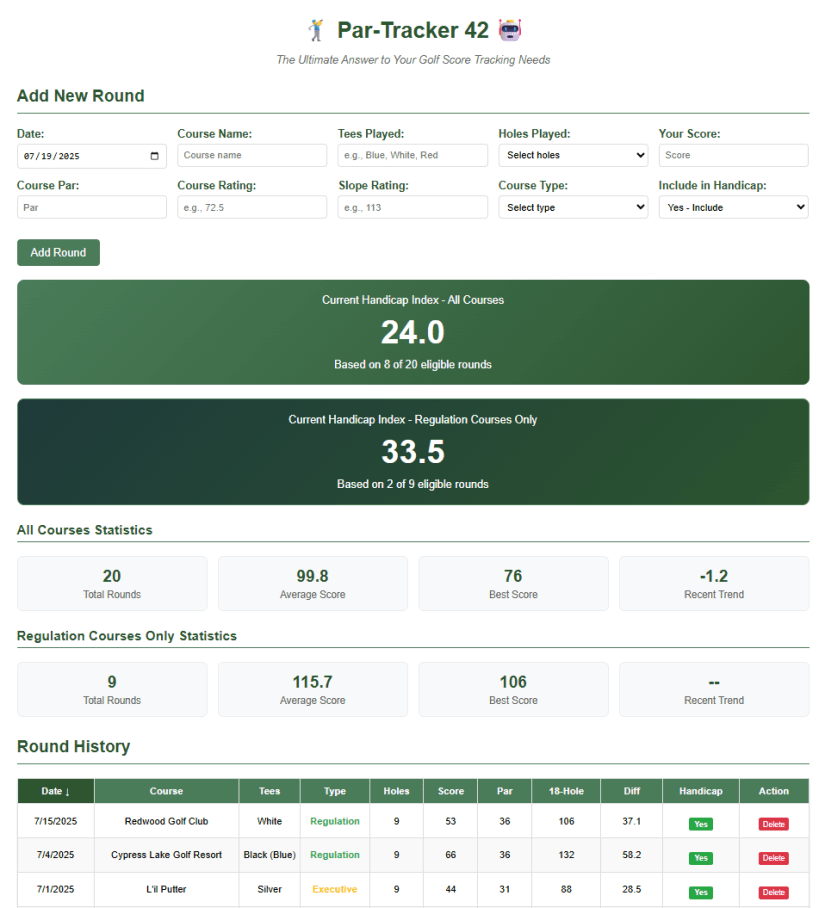
That experience really showed me the power of vibe coding. It feels like the next evolution of the DIY maker movement. We are no longer limited to tinkering in the woodshop or wiring up Raspberry Pis. Now we can get deep into the code side too. Why buy when you can build? (Not always the right call, but more on that later in the series.)
That little moment when something half imagined turns into something you can click and see is the hook. You start stacking small wins: fix this, improve that, ask AI for an edge case you forgot. You realize that for once you are building faster than you can overthink.
Sure, it is not always perfect, and that is both a pro and a con, but in those moments the vibes are very real.
Takeaway: The Magic (and the Mirage)
Vibe coding unlocks something that many of us lose along the way: creative momentum. It is what happens when you stop fighting the process and start flowing with it.

You do not have to be an expert in every framework or memorize every syntax quirk. You just need curiosity and a willingness to explore. The AI handles the boilerplate, and you handle the vibe.
It is not about cheating or cutting corners; it is about changing the relationship between human intention and machine execution.
That is The Good, the thrill of getting your ideas off the ground faster than ever. But as anyone who has hit “generate” a few too many times knows, sometimes the vibe fades.
Join us next time as we trade our white hats for black hats and dive into “The Bad” of vibe coding. We will look at what happens when the magic starts to slip, the hidden costs, and why every good vibe needs a reality check.
(And yes, this post was vibe coded too. Sometimes I am the writer and my AI buddy is the editor. Other times they are the writer and I am the editor. And when we are both stuck, we call in Clippy, the original AI superstar. 🌟)

Until next time, keep the good vibes going because you never know when a good vibe might go bad…

All the Links: bio.link/thebimsider

 The BIMsider
2 thoughts on “Vibe Coding: The Good”